
Why Every Product Team Needs Ethics by Design
And how we can embed it without slowing innovation
Design isn’t just about screens or flows. It shapes our behavior, enabling decisions, and guiding interactions at scale. As designers, we don’t just reflect the world—we help construct it. That’s why we need ethics embedded in the way we work. Not as a compliance checkbox or philosophical sidecar, but as a natural part of the creative process. And as our tools grow more powerful—infused with data, driven by algorithms, and scaled to millions—the weight of that responsibility increases.
Ethics by Design is an approach to do exactly that: Practical, scalable, and grounded in lived product experience. It isn’t about slowing teams down or restraining innovation. It’s about helping teams move forward with clarity, courage, and care.
Design is Power. What Should We Do With It?
Every product decision is a value judgment.
So let’s make them with eyes open.
Designers influence how people access information, connect with others, spend their money, and make decisions. That kind of influence carries weight—whether we acknowledge it or not.
We’ve all seen what happens when products are built without ethical foresight: biased algorithms, dark patterns, surveillance creep, and exclusion masked as edge-case neglect. These aren’t unfortunate byproducts. They’re predictable results of ignoring how power, privilege, and responsibility play out in design.
This work begins by recognizing that we always bring values into the room. The question is whether we do so intentionally.
Ethics by Design asks us to consider:
• Who are we designing for—and who gets left out?
• What assumptions are baked into our defaults?
• What downstream consequences might arise?
It’s not about perfection. It’s about awareness. Awareness leads to choice. And choice is the designer’s true superpower.
Making Ethics a Feature, Not a Bottleneck
Responsible design doesn’t mean saying no. It means asking better questions.
Too often, ethical considerations are treated like stop signs: “Don’t do this. Watch out for that.” But the best ethics work is generative—it opens up new ways of thinking, designing, and building.
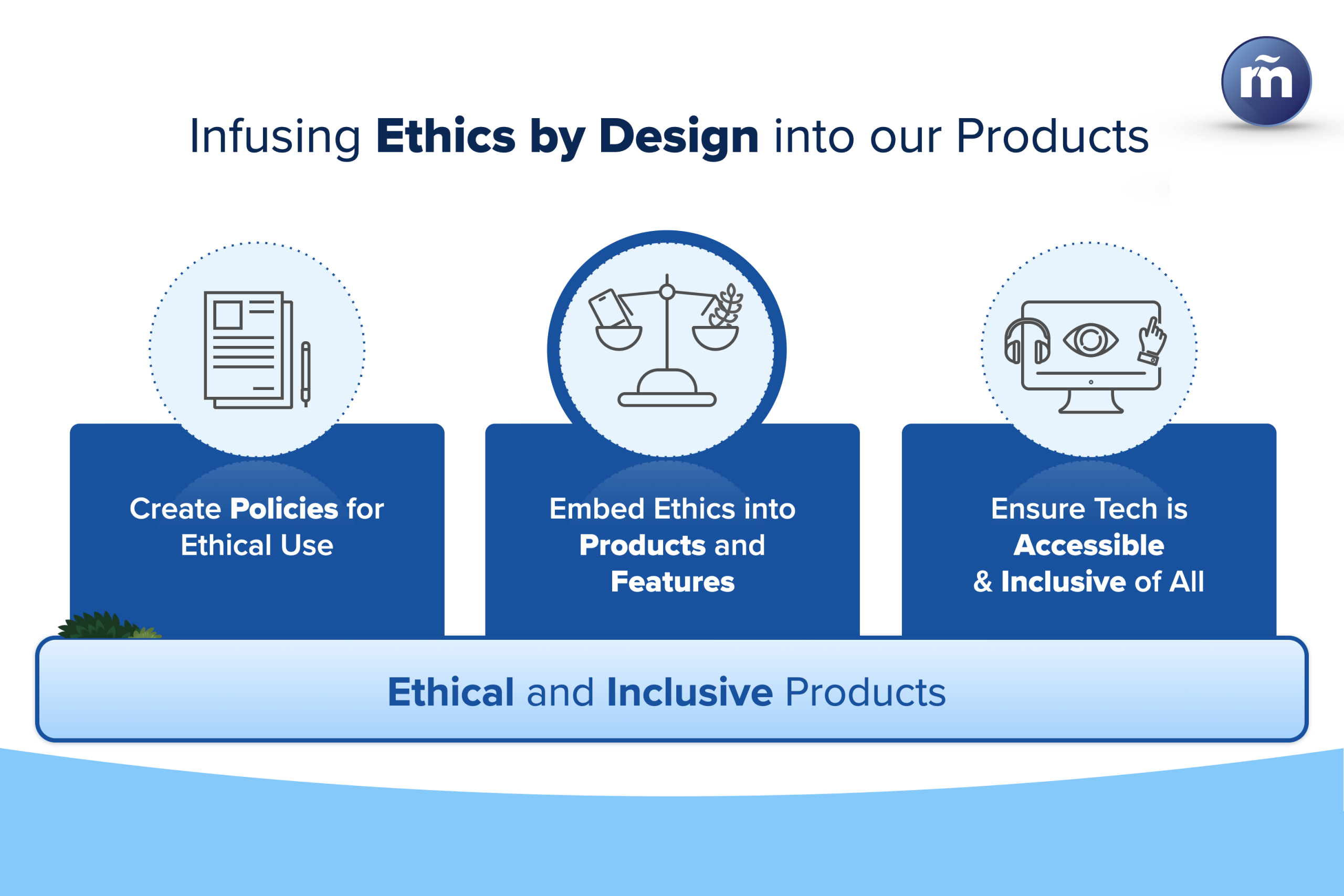
At Salesforce, I built a program to make ethics operational. That meant moving beyond abstract principles into tools teams could actually use:
- Lightweight facilitation frameworks to guide ethical reviews
- Scenario mapping and harm forecasting templates
- Prompts to spark deeper discussions during key design milestones
We worked ethics into the same spaces where usability, accessibility, and technical constraints were already discussed. The result? Teams didn’t slow down—they made smarter, more confident choices. Ethics became a lens, not a roadblock.
This kind of integration is what makes ethics sustainable. It’s not a separate discipline—it’s part of design maturity.
Trust Isn’t a Widget. It’s a System.
The invisible threads that make products safer, fairer, and more inclusive.
Trust isn’t built with a privacy policy or a cute onboarding screen. It’s cultivated through consistent, considered design choices that honor users’ needs and agency.
I think of trust as expanding in concentric circles:
- First, users must believe the product will do what it says.
- Then, they begin to rely on it for more meaningful tasks.
- Eventually, they might share sensitive data or let it act on their behalf.
But those outer circles only unlock if each inner one is well-earned. If we break trust early—through confusing UX, opaque decisions, or unexpected consequences—we don’t just lose users. We lose legitimacy.
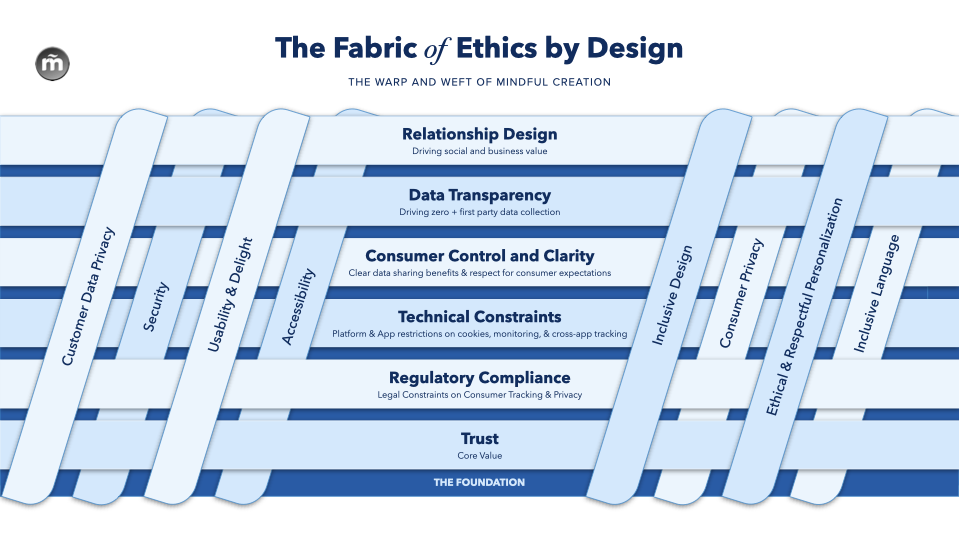
The fabric of ethical design includes:
- Transparency: How clearly do we communicate system intent?
- Inclusivity: Whose realities and access needs are accounted for?
- Autonomy: Can users understand and influence what the system does
- Accountability: Are we designing for responsibility, not just efficiency?
We don’t have to treat these values as idealistic. In fact, we should not. They are practical levers for better, longer-lasting products.
Proof Over Promise
Inside the toolkit that helped teams at Salesforce rethink risk, fairness, and user agency.
Theory is one thing. Doing it inside real orgs, with timelines, KPIs, and launch pressure? That’s where it gets interesting.
At Salesforce, I co-created the Ethics by Design Toolkit—a modular resource for designers, PMs, and engineers to evaluate their work through an ethical lens. We tested it on high-stakes projects like AI-powered personalization and lead scoring.
The outcomes weren’t just philosophical. They were tangible:
- Teams redesigned workflows to reduce amplification of historical bias.
- Feature success criteria were redefined to include clarity, fairness, and user control.
- One team even chose not to automate a task after recognizing the ethical cost of stripping away decision-making from users.
The toolkit made it easier to do the right thing—and just as importantly, to know what the right thing was.
The Case for Ethics
Ethics in Practice

A Conceptual Framework for Ethics Practice
Thoughtful experiences for complex design challenges
See case studies that offer a taste of the projects I’ve designed and directed at Salesforce and Bank of America.